Guangzhou Haike Electronics Technology Co., Ltd.
E-mail: eva@gzhaike.com
Address: 613th Tainan Rd, Dongchong Town, Nansha District, Guangzhou, 511453, PR. China.
6-12 months. Although it depends on the specific filter you have, as a rule of thumb, replaceable HEPA filters should be replaced every 6-12 months, depending on air quality and environmental factors. Carbon pre-filters should be replaced every 3 months, depending on air quality and environmental factors. A HEPA filter is a fibrosis air filter typically made of plastic fibers (polypropylene), fiberglass, or borosilicate glass fibers. These fibers are bound closely together (often using a 5% acrylic binder) to restrict certain particles from getting through.

HEPA filters.
The glass fibers that make up a HEPA filter are created by passing molten glass or plastic through very fine pores in a spinning nozzle.
The spinning nozzle moves back and forth (causing the glass fibers to form a web) above a moving conveyor belt onto which the fibers are collected.
It's generally recommended to change them along these timelines: True HEPA: 8,760 usable hours or about every 12 months. Activated Carbon: 8,760 usable hours or about every 12 months. Mesh Pre-Filter: Should be cleaned every 2-4 weeks.
Cons: HEPA filters however cannot trap other pollutants such as gases, fumes, chemicals, and odors. It can be costly when replacing filters. Replacing filters can become costly depending on how many times you change the filter. The shape and compactness of the unit depend on what type of air purifier you have.

You can clean and reuse a permanent HEPA filter. However, you must do it as carefully as possible to avoid damaging it. You can clean most HEPA filters using a vacuum cleaner, but that will require the utmost gentleness. On the other hand, you can rinse a washable HEPA filter with cold water.
Medical-grade HEPA filters are made from very fine paper (not polypropylene or synthetic materials) which traps microscopic particles so fine they will even remove bacteria and viruses. This is why HEPA filters are used in hospital and medical applications, including operating theatres.
It's all in the mat and the weave of fibers in the filter itself. HEPA filters use hundreds of thousands of fiberglass fibers—incredibly small and sticky for particles that try to pass through them. This tight weave of fibers then captures particles larger than 0.3 microns in size.
Changing your filter is essential in preventing health threats in more ways than one. If your filter is not changed in time, it will be clogged with microorganisms like bacteria, viruses, and mold particles. It won't be able to clean new ones and only capture them on the filter's surface.
Bottom Line: I recommend changing the HEPA every 150 days at about 8 hours a day or approximately every 1,000 hours. You can adjust the number based on how many hours you use daily.
A HEPA filter is not like any regular air filter you typically put in your home. HEPA filters are pleated mechanical air filters that have a considerable thickness in order to capture the particulates. The pleats create a mat of fibers that are randomly arranged. The random, dense arrangement of fibers in the HEPA filter help to catch a range of particle sizes. As air particles pass through the air filter, they are caught by three mechanisms: diffusion, interception, and impaction.
Direct Impaction: Large contaminants, such as certain types of dust, mold, and pollen, travel in a straight path, collide with fiber, and stick to it.
Sieving: The air stream carries a particle between two fibers, but the particle is larger than the gap, so it becomes ensnared.
Interception: Airflow is agile enough to reroute around fibers, but, thanks to inertia, particles continue on their path and stick to the sides of fibers.
Diffusion: Small, ultrafine particles move more erratically than larger ones, so they’re more likely to hit and stick to fibers.
Diffusion occurs in a HEPA filter when the gas molecules that are smaller than 0.1 microns in size collide with each other and are delayed in passing through the filter. The delay will make it more likely for the next two mechanisms to occur for those smaller particles. Interception is when particles moving along the air stick to a fiber. Impaction, the third mechanism, is when the larger air particles embed directly into the fibers themselves.
A HEPA filter is a fibrosis air filter typically made of plastic fibers (polypropylene), fiberglass, or borosilicate glass fibers. These fibers are bound closely together (often using a 5% acrylic binder) to restrict certain particles from getting through.
Most HEPA filters are mechanical and commonly paired with electrostatically charged filter media, like in electronic air cleaners, which help move the air through the filter in a two-stage process. In this two stage-process, the particulate air has an electrical power source that charges the particles that pass through the filter.
In the HOKO air purifier, this charge is ionization, and it helps to encourage particles to bind to other particles, making them easier to capture by the air filter. The charcoal pre-filter also captures smoke, odor, harmful gases, and volatile organic compounds (VOCs), which HEPA filters can't catch. Leveraging ionization technology allows you to capture more airborne debris so that the HEPA filter can do its job more efficiently.
HEPA, which stands for High-Efficiency Particulate Air, is a designation used to describe filters that are able to trap 99.97 percent of particles that are 0.3 microns. Though the HEPA standard and certification process wasn’t established until 1983, the development of HEPA filters dates back to World War II, when American scientists with the Manhattan Project created the first HEPA filter to capture radioactive particles released during the creation of the atomic bomb.
That micron size (0.3) is referred to by scientists as the MPPS or the most penetrating particle size. Scientists have found that particles of that size evade air filters more than larger or smaller particles. We’ll get into why in a little bit.
HEPA is a type of pleated mechanical air filter. It is an acronym for "high-efficiency particulate air [filter]" (as officially defined by the U.S. Dept. of Energy). This type of air filter can theoretically remove at least 99.97% of dust, pollen, mold, bacteria, and any airborne particles with a size of 0.3 microns (µm). The diameter specification of 0.3 microns responds to the worst case; the most penetrating particle size (MPPS). Particles that are larger or smaller are trapped with even higher efficiency. Using the worst-case particle size results in the worst-case efficiency rating (i.e. 99.97% or better for all particle sizes).
All air cleaners require periodic cleaning and filter replacement to function properly. Follow the manufacturer's recommendations on maintenance and replacement.
Minimum Efficiency Reporting Values, or MERVs, report a filter's ability to capture larger particles between 0.3 and 10 microns (µm).
This value is helpful in comparing the performance of different filters
The rating is derived from a test method developed by the American Society of Heating, Refrigerating, and Air Conditioning Engineers (ASHRAE).
The higher the MERV rating the better the filter is at trapping specific types of particles.
| MERV Rating | Average Particle Size Efficiency in Microns |
| 1-4 | 3.0 - 10.0 less than 20% |
| 6 | 3.0 - 10.0 49.9% |
| 8 | 3.0 - 10.0 84.9% |
| 10 | 1.0 - 3.0 50% - 64.9%, 3.0 - 10.0 85% or greater |
| 12 | 1.0 - 3.0 80% - 89.9%, 3.0 - 10.0 90% or greater |
| 14 | 0.3 - 1.0 75% - 84%, 1.0 - 3.0 90% or greater |
| 16 | 0.3 - 1.0 75% or greater |
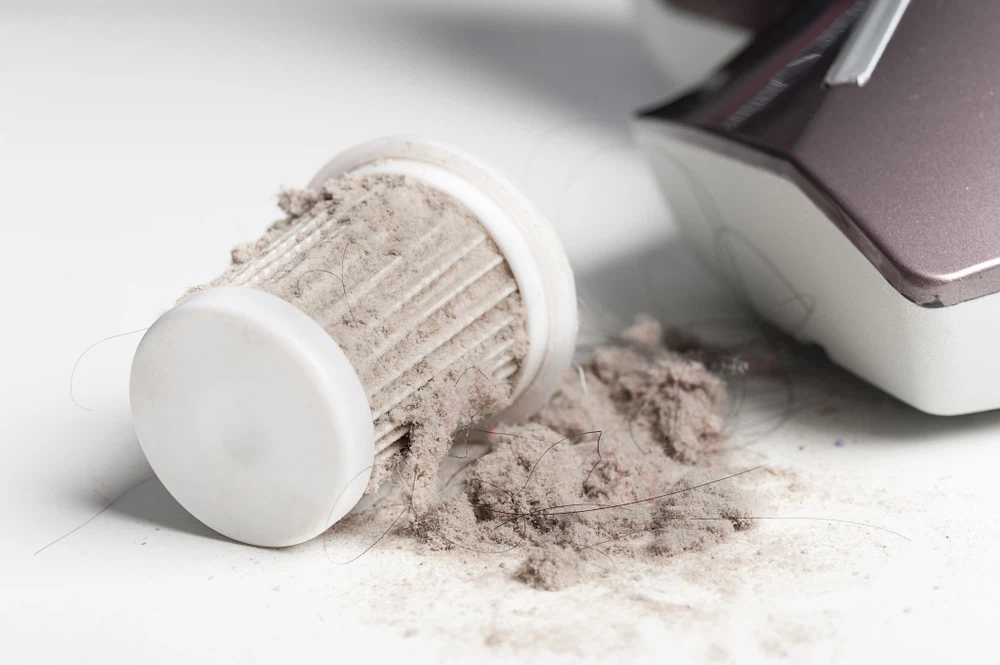
If your HEPA filter is not specifically labeled as washable or “permanent,” then the answer is no – while it may still filter the air it will have reduced effectiveness after washing. You can rinse the filter in water, tap excess dust off of it or remove some dust with a vacuum, but this can definitely damage the mesh of fibers that allows the filter to remove particles from the air. Even if the filter looks undamaged, some of the fibers will be broken or stretched out. You will end up with a somewhat clean-looking filter that does not do the job of filtering properly.
What allows a HEPA filter to meet its claims is the consistency of the “weave” of glass fibers. If the fibers are stretched or torn, it will create gaps in the filter large enough for particles to pass through. The integrity of the frame is important as well. If the frame itself or the gaskets that provide a seal between the frame and the location it is mounted in are compromised, air can flow around the filter instead of through it.
If the filter is marketed as being washable or permanent, then it is possible that you can wash it or clean it off and it will still function. However, there is no standard for washable HEPA filters, and there have not been public studies testing how well these filters work after they have been washed. It is possible that the manufacturer has found a method of making filter fibers that will not be damaged by cleaning, but there really is no way of knowing for sure, so you are taking your chances.
As discussed, cleaning a HEPA filter almost certainly will cause damage to the extremely fine mesh of fibers that allow the filter to do its job. But even if you could be 100 percent sure the filter would not be damaged by cleaning, there are other reasons that cleaning a HEPA filter is not a great idea.
Cleaning a filter is a dirty job. Unless you take the filter outside to clean it, there is a good chance that the act of cleaning it will introduce some airborne pollutants to your house. Getting rid of those pollutants is the reason you may want to use a HEPA filter in the first place. The pollutants introduced back into the air may include any microbial growth that has taken place on the filter.
You may inhale some of the pollutants from the filter. Even if you can clean your HEPA filter outdoors, some of the particles from the filter will be in the air while you clean it. Unless you wear some type of respirator, you can inhale those pollutants, which could trigger an allergic reaction.
You will need a filter for your filter cleaner. If you use a vacuum to clean out a HEPA filter, the vacuum will also need to have a HEPA filter, or it will not be able to keep the particles from the dirty filter in the canister. It will disperse all those particles into the air. And if the vacuum does have a HEPA filter, what will you use when it is time to clean that one?
The filter must be completely dry before using. A wet HEPA filter could further allow mold to form on the filter surface. Because of the fine mesh of fibers in a HEPA filter, they take a long time to dry (manufacturers recommend at least 24 hours). The whole time the filter is drying, you are not filtering the air.
The general recommendation is that HEPA filters should be replaced, not cleaned. But if you absolutely have to clean a HEPA filter, there are two ways to do it. Which method you use depends on what type of HEPA filter you have. Because there are no official standards for cleanable HEPA filters, there are no defined terms for the types of cleanable filters available. However, manufacturers have adopted certain marketing terms with some consistency: washable and permanent.
A washable HEPA filter should be cleaned by rinsing it under cold water. You should be careful not to touch the filter material, only allowing it to come in contact with water. Allow the filter to completely dry before reinstalling it. Some filters have special instructions. For instance, some canister-type vacuum filters should only be washed on the outside of the filter, being careful to avoid getting the central part of the canister wet.
A HEPA filter marketed as “permanent” should be cleaned by gently using a vacuum cleaner to suck away dust and debris from the surface of the filter. Water should not be used on these types of filters.
Click the HOKO HEPA filter air purifier product to know more.
Previous: What Does An Ozone Generator Do?
Next: No Information

 русский
  日本語
日本語 Deutsch
 Italiano
 Español
 عربي
عربي  Français
 Português


